Ghost Fuel: Why the Gas Your Vintage Bike Was Built For No Longer Exists
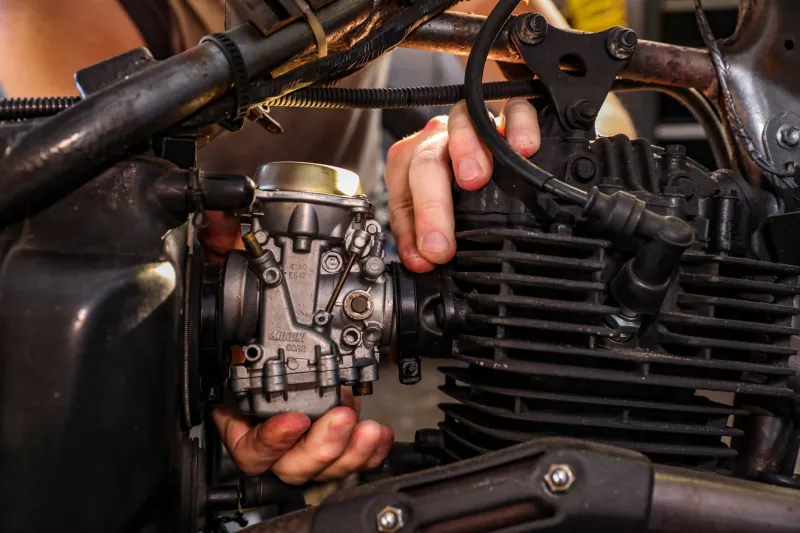
Pull up to any gas station in America today, and you'll find something your 1965 BSA or 1978 Kawasaki was never designed to drink. The pumps look familiar. The ritual is the same. But the chemistry inside that nozzle has shifted dramatically since the golden era of classic motorcycles—and those changes have real consequences for anyone trying to keep a vintage engine happy and healthy.
This isn't just mechanical trivia. It's the kind of knowledge that separates a restorer who's constantly chasing mysterious fuel system failures from one who understands exactly why they happen.
What the Old Stuff Actually Was
Gasoline in the 1950s, '60s, and into the '70s was a different animal. It was purely petroleum-based, containing no alcohol whatsoever. It was also routinely treated with tetraethyl lead—an additive that served two purposes: it boosted octane ratings without expensive refining, and it left a thin protective coating on valve seats and other metal surfaces inside the engine.
High-compression engines of that era, including many of the iconic British twins and Japanese fours that collectors prize today, were specifically tuned around leaded fuel. The octane ratings were real, the combustion characteristics were predictable, and the fuel itself was chemically stable in a way that modern blends simply aren't.
Lead was phased out of American gasoline through the 1970s and finally banned for on-road use in 1996—a decision driven by overwhelming evidence of its health and environmental harms. Nobody serious argues that lead should come back. But its disappearance left a gap that engine designers of the classic era never anticipated.
Enter Ethanol—and the Problems It Brought
The bigger disruption to vintage fuel systems came in two waves. The first was the Clean Air Act amendments of the 1990s, which pushed refiners toward oxygenated fuels. The second was the Energy Policy Act of 2005, which mandated ethanol blending through the Renewable Fuel Standard. By the early 2010s, E10—gasoline blended with 10% ethanol—had become the de facto standard at American pumps. E15 is now increasingly common, and E85 is available at select stations for flex-fuel vehicles.
For modern cars with fuel-injected engines, stainless steel fuel lines, and ethanol-compatible seals, this is mostly a non-issue. For a 1971 Norton Commando with original rubber fuel lines, brass float bowl needles, and a fiber-reinforced fiberglass tank? It's a slow-motion disaster.
Ethanol is hygroscopic, meaning it actively absorbs moisture from the surrounding air. In a vintage tank that sees irregular use, this leads to water accumulation—which leads to phase separation, where the ethanol-water mixture drops to the bottom of the tank and creates a corrosive sludge that attacks metal, clogs jets, and damages seals. Ethanol is also a solvent. It degrades the older rubber compounds used in vintage fuel lines, gaskets, and carb diaphragms, causing them to swell, crack, or dissolve entirely over time.
"I've pulled carbs off bikes that look like they've been marinating," says Greg Halstead, a restoration specialist in Portland, Oregon, who focuses exclusively on pre-1980 Japanese and British motorcycles. "The rubber parts are just gone. Not cracked—dissolved. That's ethanol doing what ethanol does to old-school materials."
The Octane Confusion
Modern pump gas is also delivering octane differently than it used to. Today's 87, 89, and 91-plus ratings are calculated as an average of two different measurement methods (RON and MON), whereas older American ratings were based on a single method. The practical effect is that modern 91 octane doesn't behave identically to the 91 octane your bike's carburetor jetting was originally calibrated for.
High-compression vintage engines—particularly the big British twins and the early Japanese performance bikes—can be prone to detonation on modern regular unleaded, especially during hot weather or under load. Running premium helps, but it doesn't fully replicate what those engines were tuned for. Some restorers use octane booster additives as a supplement, though results vary and quality across brands is inconsistent.
What the Fuel Does When It Sits
Modern gasoline also has a dramatically shorter shelf life than its predecessors. The volatile compounds that make it ignitable begin evaporating within 30 days in an open or vented system. Ethanol-blended fuel can go stale in as little as three weeks under warm conditions. What's left behind is a varnish-like residue that coats jets, passages, and needle seats with a brownish lacquer that looks innocent and clogs ruthlessly.
For a daily rider, this is a minor inconvenience. For a classic motorcycle that gets ridden on weekends, or pulled out of storage for a summer season, it's a recurring headache.
"The number one thing I tell people who bring me a bike that won't start after winter storage is this: the carb isn't broken. The fuel turned to glue," says Halstead. "Drain it completely before you put it away. Every time. No exceptions."
Practical Solutions That Actually Work
The good news is that none of this is insurmountable. Restorers and everyday classic bike owners have developed a solid toolkit for managing the modern fuel problem.
Seek out ethanol-free fuel. It's more available than most people realize. The website pure-gas.org maintains a crowdsourced database of stations across the US that sell ethanol-free gasoline—often at the marine or aviation fuel pump, or at smaller independent stations. Many vintage bike owners won't run anything else.
Use a quality fuel stabilizer. Products like Star Tron, Sta-Bil 360 Marine, or PRI-G are specifically formulated to address ethanol-related degradation and extend fuel stability during storage. Add it to every tank if you're not riding regularly, and always treat a full tank before winter storage.
Upgrade vulnerable fuel system components. Modern ethanol-compatible fuel line, updated float bowl needles, and Viton rubber O-rings and diaphragms are available for most classic applications. They're not expensive, and they're dramatically more resistant to ethanol's solvent properties than original materials.
Coat or line your tank. If you're dealing with a tank that's seen repeated ethanol exposure, a quality tank liner like Kreem or Red-Kote can seal existing surface rust and create an ethanol-resistant barrier. It's not a substitute for a properly cleaned tank, but it adds meaningful protection.
Rejet for modern fuel if necessary. If your bike runs lean or detonates on modern pump gas, a slight carburetor rejetting—richer needle position or slightly larger main jet—can compensate for the different combustion characteristics of today's blends. A knowledgeable carb tuner can dial this in without compromising the bike's original character.
The Fuel Your Bike Remembers
There's something quietly poetic about the fact that the machines we love were calibrated for a world that no longer exists—built for roads that have been repaved, tuned for fuel that's been reformulated, and engineered by engineers who couldn't have imagined the chemistry that would flow through their creations decades later.
But that's part of what makes vintage motorcycles worth preserving. They require knowledge. They reward attention. And understanding something as fundamental as what you're putting in the tank isn't just maintenance—it's a form of respect for what these machines were, and what it takes to keep them alive on modern roads.