Your Bike's Birth Certificate: How to Read a VIN and Uncover Your Classic Motorcycle's Full Story
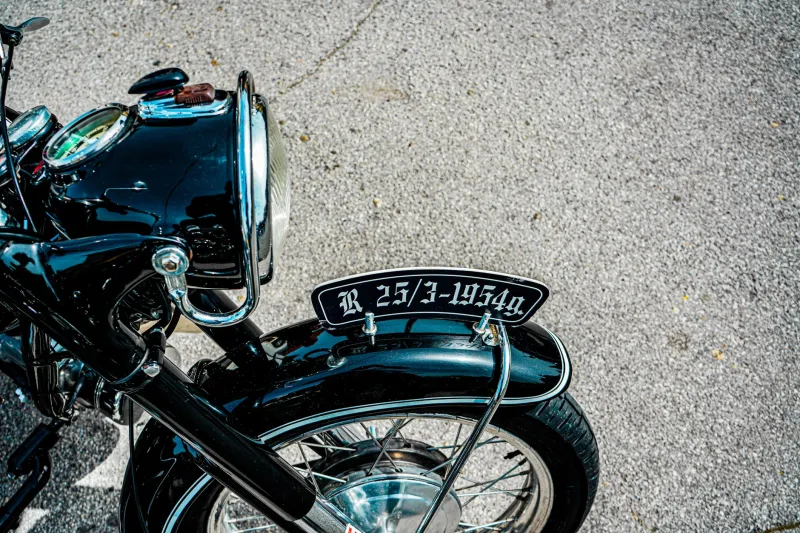
There's a moment that happens to almost every vintage bike buyer — usually a few weeks after the purchase, once the excitement has settled into something more like ownership. You're out in the garage, wiping down the tank or pulling the carbs, and you start wondering: What's the actual story here?
Where was this bike built? What color did it leave the factory? Has it been wrecked, rebuilt, or rebored? Is it the bike the title says it is?
The answers to most of those questions are already in your possession. They've been there since you bought the bike. They're stamped directly into the steel — a sequence of characters that functions like a compressed biography of your machine. The VIN, or Vehicle Identification Number, is one of the most underutilized research tools available to vintage motorcycle restorers, and learning to read it properly is one of the best investments of an afternoon you can make.
First, Understand What You're Looking At
Before 1981, there was no standardized VIN format in the United States. This is the first thing to understand, and it's the source of a lot of confusion for new collectors. If your bike was manufactured before 1981 — which covers the bulk of what most people consider "vintage" — its serial number follows a manufacturer-specific format that varies by brand, country of origin, and even production year.
Post-1981 bikes follow the 17-character standardized format mandated by the National Highway Traffic Safety Administration. This system is consistent across all makes and models sold in the US, which makes decoding straightforward once you know the structure. Pre-1981 bikes require brand-specific knowledge, which we'll get into.
The standardized 17-character VIN breaks down like this:
- Characters 1–3 (World Manufacturer Identifier): Who made it and where. "JH2" means Honda Japan. "JS1" means Suzuki Japan. "1HD" means Harley-Davidson USA.
- Characters 4–8 (Vehicle Descriptor Section): Engine type, displacement, model series, and body style. This section is manufacturer-specific even in the standardized era.
- Character 9 (Check Digit): A mathematical verification character used to confirm the VIN isn't fraudulent. Useful for spotting forgeries.
- Character 10 (Model Year): A single letter or number that corresponds to the production year. "A" = 1980, "B" = 1981, and so on — skipping I, O, Q, U, and Z to avoid confusion with numbers.
- Character 11 (Plant Code): Where the bike was assembled. Each manufacturer uses their own plant codes.
- Characters 12–17 (Sequential Production Number): The bike's place in the assembly line queue for that model year at that facility.
Pre-1981: Where Things Get Interesting
For most classic motorcycle enthusiasts, the pre-standardization era is where the real detective work lives. A 1969 BSA A65, a 1972 Honda CB750, a 1975 Triumph Bonneville — none of these use the 17-character format, and each manufacturer encoded information differently.
Honda pre-1981 serial numbers typically begin with the model designation followed by a sequential number. A CB750 from 1969 might read "CB750-1000001" — the model, then the production sequence. Honda used prefix codes to indicate engine type, frame series, and market destination. The suffix letters matter too; they can indicate whether a bike was destined for the California market (with different emissions equipment) versus the rest of the US.
Triumph used a more compact system. A 1972 Bonneville serial number like "JH12345" encodes the model prefix (JH for Bonneville 650), followed by the sequential number. The prefix also indicates the engine type and displacement. Cross-referencing these against Triumph's factory records — which have been extensively digitized and maintained by Triumph clubs — can tell you the exact build date, original color code, and which dealer it was shipped to.
Harley-Davidson pre-1981 numbers are particularly well-documented, thanks to decades of enthusiast research and the Harley-Davidson Motor Company's own historical archive. The prefix letters identify the model family and displacement; the numbers indicate production sequence. Harley's VIN structure changed multiple times between the 1940s and 1980, so knowing the specific year of your bike before you start decoding is essential.
Where to Actually Find the VIN
This sounds obvious, but it trips people up more than you'd think. On most motorcycles, the primary VIN location is the steering head — the front of the frame where the fork tubes meet the main frame. Look for a stamped or riveted plate, or characters pressed directly into the steel.
The engine cases carry a separate number — the engine serial number — which should match factory records for the bike but is not the same as the frame VIN. On a numbers-matching restoration, you want both to correspond to the same bike. Discrepancies between frame and engine numbers don't automatically mean something shady happened — engines get swapped legitimately for all kinds of reasons — but they do affect value and authenticity significantly.
On British bikes, check the steering head and the top of the engine cases near the timing cover. On early Japanese bikes, the stamp is usually on the right side of the steering head. Harleys typically carry the number on the left side of the engine cases as well as the frame.
If the numbers have been filed, re-stamped, or altered in any way, walk away from the purchase. This is a serious legal issue in most states, not just a red flag.
Turning Numbers into History
Once you have the VIN decoded to the point of knowing production year, plant, and sequence, the real research begins.
Factory records and owner registries are your best friends here. For British bikes, the Vintage Motor Cycle Club in the UK maintains extensive records, and many marque-specific clubs — the Triumph Owners Motor Cycle Club, the BSA Owners Club of America — have databases that can be cross-referenced with your serial number to pull original build specs.
Honda enthusiasts can tap into the American Honda Foundation's historical resources, and the VJMC (Vintage Japanese Motorcycle Club) maintains active forums where members have compiled decades of production data.
Harley-Davidson offers an official archive lookup service through the Harley-Davidson Museum in Milwaukee. For a modest fee, they'll pull the original factory record for your bike — including the model designation, paint color, optional equipment, and shipping destination. It's one of the most satisfying documents a Harley owner can have in their possession.
For title history and accident records, services like the NICB's VINCheck (free), the National Motor Vehicle Title Information System, and paid services like Carfax (which now covers motorcycles) can surface insurance claims, salvage titles, and odometer discrepancies going back years.
What the Numbers Tell You About Restoration Decisions
Here's where the research stops being academic and starts being genuinely useful.
Knowing your bike's original factory color doesn't just satisfy curiosity — it determines whether a correct restoration is feasible and what it's worth when complete. A Triumph finished in its original Grenadier Red is worth meaningfully more to a serious collector than the same bike painted an approximation of it. Factory color codes, cross-referenced with paint suppliers who specialize in vintage motorcycle finishes, give you a target to hit.
Knowing the production date tells you which parts are correct for your specific bike. Honda, for example, made running changes mid-year on several CB models. A bike built in the first quarter of a production year may have different carburetor jetting, handlebar clamps, or instrument clusters than one built in the fourth quarter — even with the same model designation. Getting this wrong on a restoration intended for show judging is the kind of mistake that costs points.
And knowing the accident history — or the absence of one — fundamentally changes how you approach the frame. A bike with a clean record and matching numbers that shows no evidence of major collision gets a different level of scrutiny than one with a salvage title in its past. The latter isn't necessarily a money pit, but it demands closer inspection of the frame tubes, neck welds, and steering geometry before you commit to a restoration budget.
The Bike Knows Its Own Story
There's something genuinely satisfying about this kind of research — the sense that you're not just restoring a machine but recovering a history. Every bike that left a factory floor was a specific object, built on a specific day, for a specific customer somewhere in America. The VIN is the thread that connects your machine to that moment.
Pull it. Follow it. You might be surprised where it leads.