She Leaks, She Sputters, and We Love Her Anyway: Confessions of a Vintage Bike Owner
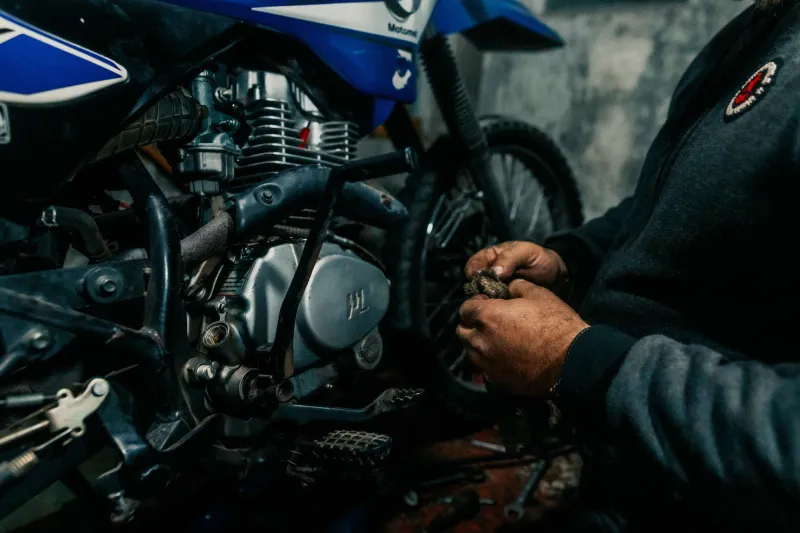
There's a saying that floats around vintage motorcycle circles, usually delivered with a knowing grin: "If it's not leaking, it's empty." It's a joke, mostly. But only mostly.
Classic motorcycles are magnificent machines. They are also, by modern standards, gloriously imperfect ones. They drip oil on your driveway, argue with you on cold mornings, and develop strong opinions about humidity. They require a level of mechanical intimacy that modern bikes — sealed, computerized, and largely self-sufficient — have made almost unnecessary. And the people who ride them wouldn't have it any other way.
This is not a takedown of vintage engineering. It's a love letter, written in oil-stained honesty.
The Leak Is a Feature, Not a Bug
Let's start with the oil. Because you always start with the oil.
Older British bikes — Triumphs, BSAs, Nortons — were built in an era when engine sealing technology was, to put it charitably, still developing. Early gasket materials weren't up to the pressures and temperatures involved, and the machining tolerances of the time left gaps that modern manufacturers would consider unacceptable. The result is that a well-loved vintage British twin will leave a small, dark calling card wherever it parks.
Harley-Davidson's early Shovelhead and Panhead engines had a similar reputation. The joke went that if your Harley stopped leaking, something had gone seriously wrong. There was even a period when some riders viewed a dry engine with genuine suspicion.
This isn't entirely irrational. Older engines used oil as a lubricant, a coolant, and in some designs, a sealant. A little seepage meant the system was pressurized and working. It also meant you learned to check your oil constantly, which meant you stayed closely acquainted with the mechanical state of your machine. There's something to be said for that.
"My '69 Triumph leaks from three places I've never been able to fully fix," says Ray Hollister, a retired schoolteacher from outside Nashville who has owned his Bonneville for going on thirty-one years. "I know exactly where they are, I know how much it loses on a long ride, and I carry a small bottle of oil everywhere I go. It's just part of knowing the bike."
Carburetors: Mood Rings with Jets
If the oil leak is vintage motorcycling's most famous quirk, the carburetor is its most dramatic character. Modern fuel-injected bikes start reliably, run consistently, and adjust to altitude and temperature automatically. A vintage carbureted motorcycle does none of these things without your involvement.
The Amal carburetors on British bikes, the Bing units on older BMWs, the Keihin carbs on early Hondas — all of them have personalities. They have preferred starting rituals. They have opinions about ambient temperature. They will flood if you look at them wrong on a cold November morning and run lean on a hot July afternoon if you don't compensate with the choke.
Mastering a vintage carburetor is less a mechanical skill than a relationship. You learn its moods. You learn how many kicks it wants before it'll catch. You learn that the tickler button is your friend in winter and your enemy in summer. And when you finally get it dialed in — when the bike fires on the second kick and idles smooth and pulls cleanly through the rev range — the satisfaction is disproportionately enormous.
"People watch me start my '64 BSA and think I'm doing some kind of ritual," laughs Denise Okafor, who rides out of Chicago and has been a BSA devotee for fifteen years. "And I kind of am. But I know that bike. I know exactly what it needs. That's not a burden. That's a skill."
The Electrical System Situation
We cannot discuss classic motorcycle engineering without acknowledging the electrical systems, specifically the British ones. Lucas Electronics, which supplied wiring and electrical components to most British motorcycle manufacturers through the 1950s, '60s, and '70s, has achieved a kind of legendary status among vintage riders — not for reliability, but for the opposite.
Lucas electrics are the subject of more jokes than almost anything else in the vintage motorcycle world. The connections corrode. The grounds fail. The charging systems are optimistic at best. Riding a vintage British bike at night in the rain is an act of either great confidence or great faith, depending on your relationship with the electrical system.
And yet — and this is the important part — these systems are almost always fixable with basic tools and a wiring diagram. There's no ECU to confuse. No proprietary diagnostic software required. A bad ground is a bad ground, and you can find it with a test light and patience. This repairability, this transparency of design, is one of the things vintage riders genuinely treasure.
"I broke down in rural Kentucky on a trip last summer," recalls Tom Vesper, a long-haul vintage rider from Virginia. "Turned out to be a failed connection in the ignition circuit. I found it, spliced it with a bit of wire I carry in my kit, and was back on the road in forty minutes. Try doing that with a modern bike's electronics."
Simple Machines, Real Consequences
Here's the trade-off that every vintage rider eventually makes peace with: mechanical simplicity is wonderful right up until it isn't. Classic bikes are repairable because they're not complex. But they're not complex because engineers in the 1950s and '60s didn't have access to the materials, manufacturing tolerances, or design tools that modern engineers take for granted.
This means valve clearances drift. Chains stretch faster than modern O-ring designs. Drum brakes, charming as they are, require more planning distance than modern disc setups. Points-based ignition timing drifts with wear. These aren't catastrophic failures — they're the normal operating reality of the technology — but they demand regular attention from the rider.
The flip side is that giving that attention is genuinely satisfying. Setting valve clearances on a vintage twin is a tactile, meditative process. Adjusting a primary chain is something you can do with tools you probably already own. There's a directness to the mechanical relationship that riders find addictive once they're in it.
Why We Keep Riding Them
Ask a longtime vintage rider why they put up with the leaks and the cold-start rituals and the electrical gremlins, and you'll get a version of the same answer every time. It's not in spite of those things. It's partly because of them.
Modern motorcycles are extraordinary machines. They're faster, safer, more comfortable, and more reliable than anything that came before. They're also, in some fundamental way, less demanding. Less present. You can ride a modern bike without ever really thinking about it.
A vintage motorcycle won't let you do that. It insists on your attention. It rewards mechanical curiosity and punishes complacency. It connects you to the road and to the machine in a way that feels increasingly rare in a world full of automated everything.
The oil stain on the driveway isn't a problem. It's proof that you were out there riding something real.
And that's worth a few extra quarts of oil any day of the week.