After Midnight in the Garage: The Secret Life of the Late-Night Restorer
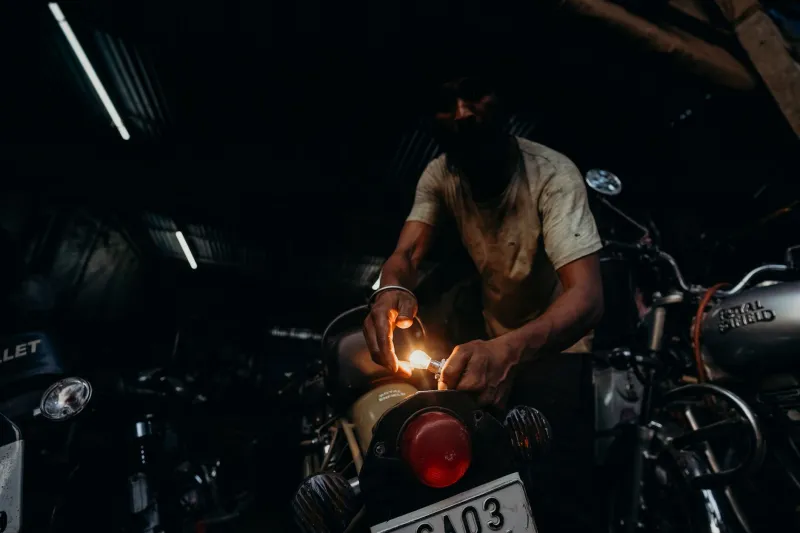
The clock on the wall says 12:47 a.m. The coffee in the mug went cold an hour ago. Somewhere in the house, a dog shifts on the couch and sighs. But out here, under the buzz of a single shop light, a 1969 Triumph Bonneville is slowly — piece by deliberate piece — becoming itself again.
This is the hour the midnight mechanic lives for.
Ask around in the restoration community and you'll find them everywhere. Guys and women who spend their daylight hours at jobs, running errands, dealing with the noise of modern life — and who quietly disappear into their garages after dinner to do the work that actually matters to them. Not because they have to. Because something out there in the dark, with grease on their hands and a torque wrench nearby, feels more real than almost anything else.
Why the Quiet Hours Hit Different
There's actual psychology behind this. Researchers who study creative problem-solving have found that the brain operates differently when environmental stimulation drops. Fewer inputs competing for attention means more cognitive bandwidth for the task at hand. The prefrontal cortex — the part of your brain responsible for deep focus and creative reasoning — gets to stretch out a little.
For a restorer staring at a seized carburetor or a wiring harness that looks like spaghetti from 1972, that mental space isn't a luxury. It's a necessity.
Dave Kowalski, a machinist from outside Milwaukee who's been restoring vintage Harleys for going on thirty years, puts it plainly. "During the day, I'm thinking about five other things. At night it's just me and the bike. I hear things I don't hear otherwise — a click that tells me something's not seated right, a rattle that points me straight to the problem. It's like the machine talks louder when the world gets quiet."
That's not mysticism. That's focused listening. And it's a skill that gets sharpened significantly when the neighborhood is asleep.
The Garage as a Different Kind of Space
There's a reason so many restorers describe their garages in almost sacred terms. It's not just where the work happens — it's where they go to think. To process. To be alone with something that demands total honesty from them.
A classic bike doesn't care about your bad day. It doesn't respond to shortcuts or wishful thinking. You either torqued that bolt correctly or you didn't. The points gap is either right or it isn't. That kind of unforgiving clarity is, for a lot of people, exactly what they need.
Late-night work amplifies this. The usual social pressures and performance anxieties that follow us around during waking hours tend to evaporate somewhere around 11 p.m. There's nobody to impress. Nobody to explain yourself to. It's just you and the problem in front of you.
Angela Reyes, who restores vintage Honda CB-series bikes out of her garage in Tucson, describes it as the only time she feels genuinely uninterrupted. "I tried working on bikes during the weekend afternoons for years. Neighbors stopping by, kids from next door asking questions, my own brain jumping to the grocery list. At night, all of that just... stops. I've solved problems at 1 a.m. that I couldn't crack in three afternoons of trying."
The Rituals That Make It Work
Midnight mechanics tend to have their routines, and most of them will defend those routines fiercely. The specific mug. The particular playlist — or the deliberate silence. The order in which tools get laid out. These rituals aren't superstition, even if they can look that way from the outside.
They're anchors. Consistent small actions that signal to the brain: we're switching modes now. We're going deep.
Some restorers keep a notepad on the workbench specifically for the ideas that surface during late-night sessions — not just mechanical solutions, but design decisions, sourcing leads, questions to chase down. The late-night garage becomes a kind of incubator for the whole project.
There's also something to be said for the physical rhythm of the work itself. Cleaning a set of carbs. Polishing chrome. Carefully unwrapping decades of electrical tape from a wiring loom. These repetitive tasks create a meditative state that's genuinely hard to access during the chaos of daytime. Your hands are busy; your mind is free to wander into solutions.
What the Machine Teaches You
Here's the thing nobody tells you about late-night restoration work: you learn things about yourself that you don't learn anywhere else.
Classic bikes — especially the older iron, the pre-electronic stuff — are brutally honest machines. Every system is visible. Every function is mechanical and traceable. When something doesn't work, there's a reason, and that reason can be found if you're patient enough and honest enough to keep looking.
That mindset bleeds into the person doing the work. Midnight mechanics tend to develop a particular kind of methodical confidence. Not arrogance — the machines humble you too regularly for that — but a quiet trust in the process. You've been stuck before. You've found the answer before. You'll find it again.
Terry Hollowell, who runs a one-man restoration shop out of a converted barn in rural Virginia, says the late-night hours changed how he approaches problems in general. "When you spend enough time alone with a machine that won't lie to you, you start applying that to everything. You stop guessing and start actually looking. You stop assuming and start testing. The bike teaches you that."
The Shop Light as a Different Kind of Spotlight
There's a particular quality to the light in a late-night garage that photographers and painters would recognize immediately. A single overhead shop light throws deep shadows. It makes surfaces dramatic. It turns a scratched tank into something that looks almost like a landscape.
Restorers who work these hours often talk about seeing their bikes differently at night. Details that disappear in the flat light of an open garage door become stark and visible under artificial light. Surface irregularities. Hairline cracks. The ghost of original pinstriping under layers of old paint.
The same principle applies to the work itself. Problems that seem diffuse and complicated in daylight become cleaner and more defined when you're working in a small pool of light with nothing else competing for your attention.
The Unsung Hours Behind Every Finished Build
Next time you see a beautifully restored classic at a show — the kind of bike that makes you stop walking and just stare — think about what it took to get there. Not just the money or the parts, but the hours. Specifically, the quiet hours. The 1 a.m. hours when everyone else was asleep and some determined person was out in their garage, alone with a machine that needed them.
Those hours don't make it onto the show placard. They don't show up in the Instagram posts. But they're in every line of that restoration, whether you can see them or not.
The midnight mechanic knows this. And honestly, that's enough.