Push, Pull, or Kick: Why the Way You Start Your Bike Says Everything About the Rider You Are
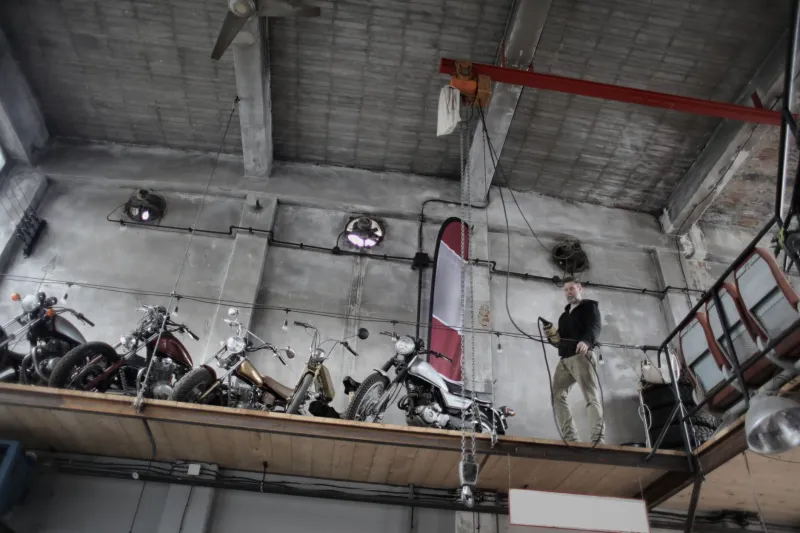
There's a moment — brief, almost invisible — that happens before every ride. You settle onto the seat, your hands find the grips, and then you have to make a choice. Button or boot. Electric starter or kickstarter. For most riders on modern machines, it's not even a thought. But for the people who wrench on and ride classic bikes, that choice is practically a philosophy.
Few components in motorcycle history have stirred as much debate, pride, or outright tribalism as the electric starter. It arrived quietly, changed everything, and left a cultural fault line that the vintage riding community is still navigating decades later.
How We Got Here: A Quick History of Cold Engines and Warm Arguments
For the first half of motorcycling's history, there was only one way to wake up an engine — physically. You flooded the carb, set the choke, said a small prayer, and drove your leg downward with everything you had. The kickstarter was less a feature and more a fact of life. It demanded a working knowledge of your engine, a feel for compression, and enough stubborn energy to keep trying when the bike didn't cooperate on the first — or fifth — attempt.
Harley-Davidson introduced an electric starter on the Electra Glide in 1965, and the name itself told the whole story. Honda had already begun threading electric starters into smaller displacement machines in the early '60s, and by the time the 1970s rolled around, the button was becoming standard across most categories. The message from manufacturers was clear: riding shouldn't require a workout before you even leave the driveway.
On paper, it was pure progress. In practice, it split the riding world right down the middle.
What the Kickstart Actually Demands From You
Ask anyone who's spent serious time with a kickstart-only machine and they'll tell you the same thing — you can't fake it. You have to know the bike. You learn the compression stroke by feel. You understand what the choke position means at 40 degrees versus 70. You develop a rhythm that's part muscle memory, part mechanical intuition.
Dave Kowalski has been restoring British twins out of his garage in Wichita, Kansas for going on 22 years. He's got a Triumph Bonneville from 1969 and a BSA A65 that he describes as "a work in permanent progress." Neither has ever seen an electric starter.
"People watch me kick that Triumph over and they think I'm performing," he says with a laugh. "I'm not. That's just how you ride the bike. You learn it like you learn anything — by doing it wrong a hundred times until you stop doing it wrong."
That learning curve is exactly what some riders find so compelling. There's no shortcut. The kickstarter makes the relationship between rider and machine immediate and physical in a way that a button simply doesn't replicate. When the engine catches and settles into its idle, you earned that sound.
The Button as a Gateway — and What Got Left Behind
It would be easy — and wrong — to frame the electric starter as the villain of this story. It isn't. What it did was open motorcycling to a vastly wider audience. Riders with physical limitations that made kick-starting impossible gained access to the freedom of two wheels. Smaller riders, older riders, and people who simply wanted transportation rather than a mechanical relationship could now participate.
That matters. A lot.
But something did shift in the culture as the button became universal. The barrier to entry dropped, and with it went a certain shared vocabulary. When every new rider could start a bike with a thumb, the tacit knowledge that kickstart machines demanded began to feel like a specialty rather than a baseline. It became a niche. And like most things that become niches, it developed an identity — and a community fiercely protective of it.
Jennifer Tran, a vintage Honda collector based in Portland, Oregon, came to kickstart machines from the modern side. She rode a late-model sport bike for years before picking up a 1972 CB350 at an estate sale.
"The first week I had that bike, I was furious at it," she admits. "I couldn't get it started consistently. I thought something was wrong with it mechanically." She laughs. "Nothing was wrong with it. I just didn't know how to talk to it yet. Once I figured it out, I understood why people are so attached to this stuff. It's not nostalgia. It's a real skill."
Restoration and the Starter Question
For restorers, the electric starter question comes up constantly, and it's rarely simple. Many classic bikes that originally came with kickstart-only configurations get modified over the years — electric starter conversions aren't unheard of, especially on bikes that see regular street use. For some owners, that's a practical decision. For others, it's close to sacrilege.
The purist position holds that if the factory didn't install a button, you shouldn't either. The counterargument is that motorcycles were always working tools, and adapting them to modern use is part of keeping them alive.
Kowalski lands somewhere in the middle. "I wouldn't convert one of mine. But I'm not going to tell someone else they're wrong for doing it," he says. "If the choice is between someone riding a classic bike with an electric starter or that bike sitting in a barn forever, I know which one I'd pick."
That tension — authenticity versus accessibility, preservation versus use — runs through nearly every restoration conversation in the classic community. The starter is just where it tends to surface most visibly.
Why Younger Riders Are Choosing the Hard Way
Here's the part that surprises people: a growing number of younger riders are actively seeking out kickstart-only machines. Not because they can't afford better, and not out of ignorance about what they're getting into. They want it specifically because it's harder.
In a world where nearly everything responds instantly to a tap or a swipe, the deliberate, full-body ritual of kicking an engine to life carries real appeal. It's analog in an era of endless digital feedback. It requires presence. You can't be distracted when you're setting the choke and positioning your foot on a kickstarter — the bike won't let you be.
Social media has played a role too. Videos of clean vintage bikes being kicked to life rack up views and comments in the classic moto community in a way that button-start walkarounds simply don't. There's a performance quality to it, yes, but underneath the aesthetics is something genuine — an appreciation for machines that ask something of their riders.
One Kick at a Time
The electric starter didn't ruin motorcycling. It expanded it. But the kickstarter didn't disappear either — it became something more than a mechanical necessity. It became a statement, a ritual, a rite of passage that the classic bike world has quietly adopted as one of its defining characteristics.
Whether you're a lifelong wrench-turner who never knew anything else, or a modern rider who bought a vintage machine just to understand what all the fuss is about, the act of kicking an engine to life will teach you something about patience, persistence, and the particular satisfaction of earning your ride before it even begins.
The road doesn't care how you got the engine running. But you will.